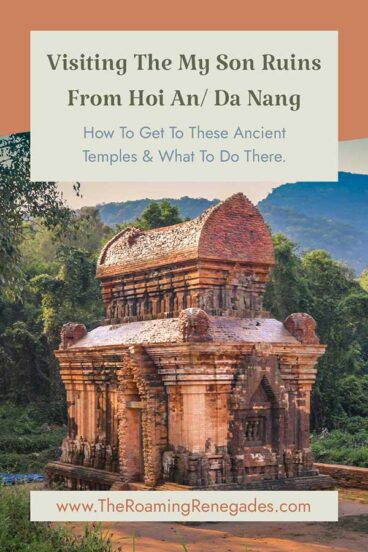
By now everyone knows about the Angkor Wat ruins of Cambodia, the highlight of the ancient world in Southeast Asia. But it must come as no surprise that they are not the only UNESCO-listed historic sites in the region. My Son ruins, of Champa origin, might not have the grand scale of Angkor, but their history has become intertwined with that of the Vietnam/ American war, which makes this site all the more miraculous.
We headed over to the My Son Temples on a day trip from the town of Hoi An.
Rolling out of one UNESCO heritage site, that of Hoi An, we set off on our beloved Honda Blades the 50 or so km, towards yet another UNESCO site. One we confess to knowing little of beforehand other than the name and the tag of “must see!” Set within the picturesque mountains of central Vietnam, the My Son temples are a collection of Champa temples inhabited from the 3rd to the 14th century.
My Son was an important place for the Cham people, a Hindu civilisation and people who predate the country of Vietnam, when this region was inhabited mostly by kingdoms, tribes and settlements. Many of the ancestors of these people still exist and identify to this day as Cham-Vietnamese, speaking their own language but adhering mostly to Buddhism since the 15th century.
The temples at My Son were dedicated to the Hindu god of Shiva and was the site of many of the religious ceremonies for the ruling kings of the Champa kingdom and burial place for royalty also.
My Son temples are also known to be one of the longest inhabited archaeological sites in Indochina, making it in turn one of the most important in Southeast Asia. In many of the newer structures, you can see the encroaching Buddhist influence as the religion swept this region towards the end of the Champa reign.
The roles they played during the war
The “ruins” are, of course, to be found today in various states of decay, but wandering through the peaceful mountain valley, the trickle of the stream and the whistling of the wind in the trees, it’s hard to imagine this place as anything but peaceful.
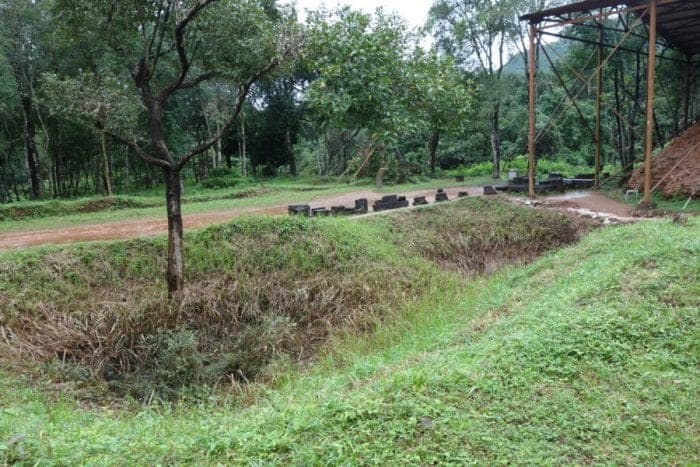
Then you come across huge and unnatural craters in the surface of the earth, much more undulating than the naturally flat lands of the riverside. You notice the smashed pieces of ornately carved stones and the towers being propped up by layers of scaffolding.
The site here at one point numbered up to 70 intricate and beautiful temples. That was until the Vietcong began to use this whole area as a base. Of course, the Americans reacted to this in the only way they knew how, by dropping carpet bombs on the whole complex.
Luckily, many of the structures were built of only bricks and, without mortar, could be painstakingly pieced back together by conservationists in the years following the war. This is just another reminder of the cost of this deadly war on not only the people but their history and culture too.
The ruins today
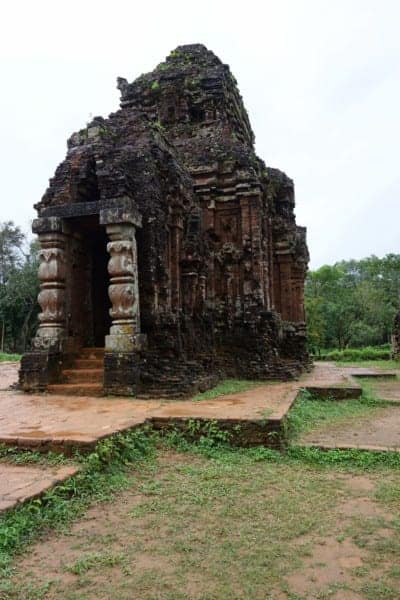
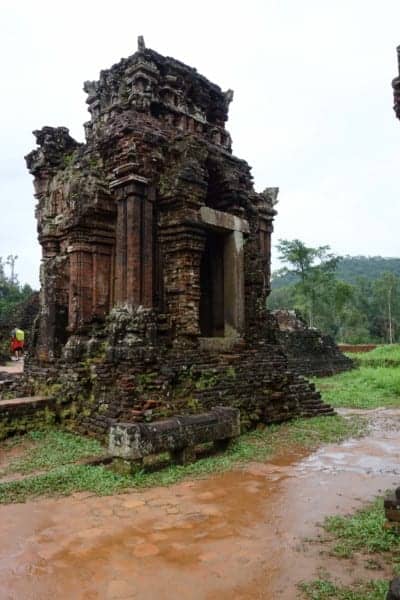
Much of the site remains in its original condition or has been lovingly restored by a team commissioned by UNESCO. The temples have that overgrown, forgotten-world feeling to them that makes places like Angkor Wat, for example, just so special to visit.
That crumbling aesthetic of a civilisation lost to time being discovered hidden amongst the mountains and jungles of this region really is quite a special and now thankfully peaceful place.
Visiting the My Son temples really gives you the chance to step back in time and walk in the footsteps of a people all put lost to the modern world. To see architecture like no other and experience a meeting point of cultures and religions.
The bright red brick of the temples contrasts sharply with the green of the lush countryside that surrounds them, a truly beautiful place regardless of your interest in history. Visiting the nearby museum is also a worthwhile stop-off point for some context to the ruins, as well as images from before the war.
How to visit My Son temples And Cost
The My Son temples lie around 50km from the town of Hoi An, a tourist hotspot most are likely to at least pass through on their way through Vietnam.
We were travelling the country on motorbikes and, as such, used our own bikes. If you can, we highly recommend taking your own transport here and exploring at your own pace. However, if you can’t do that, then there are plenty of tours you can take instead.
Information For Your Visit
Opening hours: 06:00–18:00
Ticket office: Closes at 17:30
Foreign adult ticket: 150,000 VND
Vietnamese adult ticket: 100,000 VND
Children (5–15): 30,000 VND (service/shuttle ticket)
Children under 5: Free
From Hoi An: 35–45 km (45–60 minutes)
From Da Nang: 45–70 km (1 hour 15 minutes–1 hour 30 minutes)
Motorbike parking: 10,000 VND
Estimated costs for tours:
Group tour: 400,000–600,000 VND (£12–£18) per person.
Small-group tour: 500,000–700,000 VND (£15–£21) per person.
Tour with boat ride back to Hoi An: 500,000–750,000 VND (£15–£22) per person.
Private car and driver: 600,000–900,000 VND (£18–£27) per vehicle, excluding entrance fees.
Private guided tour: From approximately £50–£80 per person, depending on group size and inclusions.
Travel insurance is one of those annoying things that no one likes to think about, let alone pay for, when you’re planning your next trip. It can also be bloody annoying as a backpacker/long-term traveller to find affordable coverage that meets the itinerary-less lifestyle (*cough* World Nomads *cough*).
So instead of getting subpar travel insurance, now we just always go with SafetyWing. It takes like 5-10 minutes to purchase your policy and essentially functions as a monthly subscription plan with near-global coverage!
For transparency’s sake:Many of the links we have on our site are affiliate links. This means that when you click one of these links and make a booking or purchase, for example: accommodation, gear, insurance or transport, we earn a small commission (at no extra cost to you).Also, know that as an Amazon Associate, we earn from qualifying purchases. Most importantly, know that we still only recommend services, gear and products we believe in and our earned commission helps us keep travelling and bringing you high-quality posts and content.
Yo, I’m Nic (they/them), one-half of The Roaming Renegades.
I’m an adventure (and halloumi) obsessed traveller with a passion for hiking mountains, exploring cities, watching Arsenal win, moshing out to Rammstein in random European fields and getting hopelessly lost on a motorbike somewhere in Asia! I am also a proud member of the LGBT+ community.
I’ve explored 80 countries, lived in Australia and New Zealand, and spent months wandering Southeast Asia, South America and Eastern Europe, all while trying to avoid growing up!
Did it work? I dunno, but my back hurts, and I still collect Pokémon cards! Who wants in?!
I’m so glad you wrote about this site as I’ve never heard of it. The ruins are beautiful and have such an interesting history. I would be one to avoid the crowded tourist bust, so I am glad there are other options, and they are much cheaper.
We value your privacy. We use cookies to improve your experience on our site. By using our site, you consent to cookies.
This website uses cookies
Websites store cookies to enhance functionality and personalise your experience. You can manage your preferences, but blocking some cookies may impact site performance and services.
Essential cookies enable basic functions and are necessary for the proper function of the website.
Name
Description
Duration
Cookie Preferences
This cookie is used to store the user's cookie consent preferences.
30 days
These cookies are needed for adding comments on this website.
Name
Description
Duration
comment_author
Used to track the user across multiple sessions.
Session
comment_author_email
Used to track the user across multiple sessions.
Session
comment_author_url
Used to track the user across multiple sessions.
Session
Statistics cookies collect information anonymously. This information helps us understand how visitors use our website.
Google Analytics is a powerful tool that tracks and analyzes website traffic for informed marketing decisions.
Used by Google Analytics to determine which links on a page are being clicked
30 seconds
_ga_
ID used to identify users
2 years
_gid
ID used to identify users for 24 hours after last activity
24 hours
_gat
Used to monitor number of Google Analytics server requests when using Google Tag Manager
1 minute
_gac_
Contains information related to marketing campaigns of the user. These are shared with Google AdWords / Google Ads when the Google Ads and Google Analytics accounts are linked together.
90 days
__utma
ID used to identify users and sessions
2 years after last activity
__utmt
Used to monitor number of Google Analytics server requests
10 minutes
__utmb
Used to distinguish new sessions and visits. This cookie is set when the GA.js javascript library is loaded and there is no existing __utmb cookie. The cookie is updated every time data is sent to the Google Analytics server.
30 minutes after last activity
__utmc
Used only with old Urchin versions of Google Analytics and not with GA.js. Was used to distinguish between new sessions and visits at the end of a session.
End of session (browser)
__utmz
Contains information about the traffic source or campaign that directed user to the website. The cookie is set when the GA.js javascript is loaded and updated when data is sent to the Google Anaytics server
6 months after last activity
__utmv
Contains custom information set by the web developer via the _setCustomVar method in Google Analytics. This cookie is updated every time new data is sent to the Google Analytics server.
2 years after last activity
__utmx
Used to determine whether a user is included in an A / B or Multivariate test.












I’m so glad you wrote about this site as I’ve never heard of it. The ruins are beautiful and have such an interesting history. I would be one to avoid the crowded tourist bust, so I am glad there are other options, and they are much cheaper.
Its a great piece of history that seems like only those on tour groups end up finding out about!! Making your own way is so much more enjoyable!
I’ve seen the Angkor Wat ruins in Cambodia but I still haven’t been in Vietnam. Have to visit this place when I go there!
They are not quite on that scale but still very impressive!
I hate that I missed these while I was in Vietnam! They look so interesting and have such a cool history. Next time, next time. A reason to go back!
Ahh, maybe next time then! Yes very interesting with ancient Vietnam and also the war
Fantastic photos! Need to visit here!
Thank you very much!