Mostar is fast becoming a popular destination for the many visitors who cram into Dubrovnik every year. Taking the day trip over to this small and unassuming Ottoman city just over the border into Bosnia and Herzegovina. Strolling across the newly restored Stari Most and around the wonderful cobbled streets of the bazaar you can be forgiven for forgetting which country you are in and the weight of history that name carries. Leave behind the areas swarming with tourists and only a few hundred metres from the famous bridge you will be confronted with a shell of a building, left to rot since it became a victim of the siege of 1992/3. We decided to take a tour, given by a now grown up child refugee, to discover what really happened here.
Why Take the Bombed-Out Buildings of Mostar Tour
Why Take the Bombed-Out Buildings of Mostar Tour

We had already set out to find many of the bombed-out buildings of Mostar during our time in the city. The history of the war in Bosnia was something that really fascinated us. Much like our interest in the troubles of Northern Ireland, with Bosnia it was a war that we remembered.
One that we grew up with on the television, the Bosnian refugees’ faces that flashed up on a daily basis. But as a child, we never really knew what was actually happening over here; we were too young to know, but we clearly remember the headlines and news flashes. It felt much more relevant to us than something like the Second World War, a time in history that we almost find too hard to comprehend living through.

But the wars in Yugoslavia and Northern Ireland, for that matter, felt more real, less like a far-gone time in history. Walking around Mostar, this comes even more into focus; you can’t help but see the ruins even if you have no interest in knowing about them.
But we also felt quite ignorant as to what really happened here; the pieces of information we had picked up over the years painted a complex story. We wanted to clear it up once and for all and see the Bombed-Out Buildings of Mostar from a local’s perspective during our time in Bosnia.
Some History of Mostar and the War
The first impressions of Mostar are an intense hit of Ottoman culture; it kind of took us by surprise. We almost felt like we had taken a wrong turn and ended up in Turkey, the minarets pointing proudly into the blue sky, displaying a much higher Muslim population than we ever imagined. We knew a little of the multicultural nature of this area of Europe, but were rather unprepared for the therapeutic calls to prayer we had grown used to during our trips to Turkey.
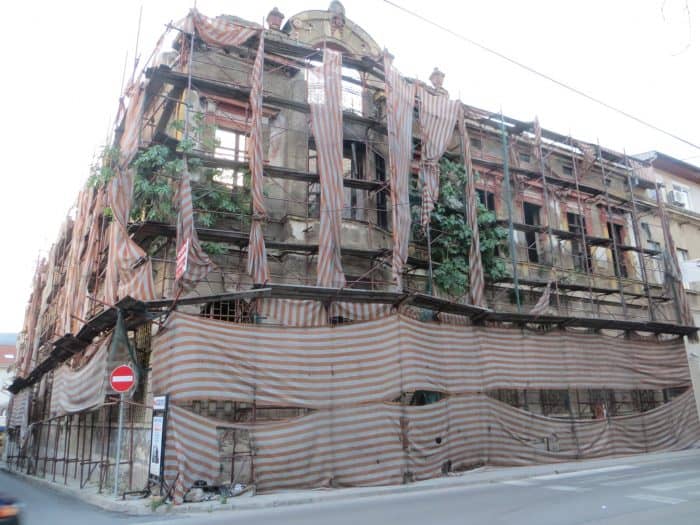
The bombed-out buildings of Mostar also hit you hard and quickly; from the bridge, the first huge ruin is only a few hundred metres away. Once the first captures your interest, you see them all, ghosts that the locals walk past like an elephant in the room. Scars dotted around almost every corner of the city.
You would be forgiven initially for thinking this was a city of ruins, but as Miran took us around the city, showing us photos of the extent of the destruction that Mostar suffered, you begin to see an opposing picture.
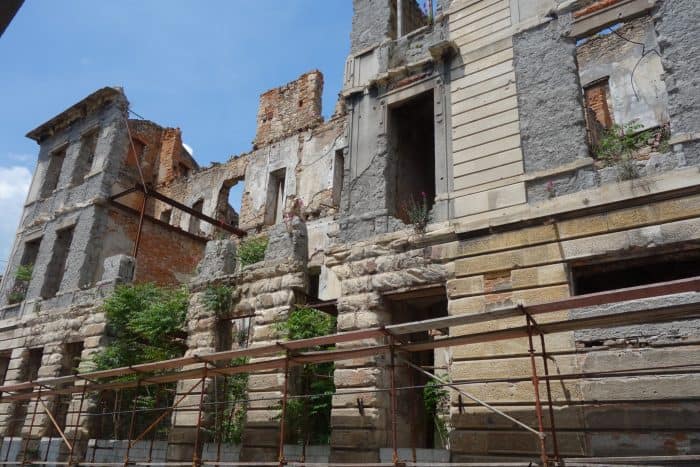
It almost seems like a miracle that Mostar is even still here to be explored; rather than a city of ruins, it is a city of regeneration, a Phoenix whose colourful wings fly high, shimmering in the late spring sun, but look closely and there are scars, patched-up feathers and a heart that still aches.
Maybe it is sad that these shells and the bombed-out buildings of Mostar still stand, that people still live inside houses pockmarked with bullet holes and hastily plastered shell holes. But then again, maybe some should always remain, as a reminder and as a memorial to what this place has had to battle through to one again become a place of such beauty.
It is quite hard to put into words how Miran managed to explain the entire war and what happened and why in Mostar. We had a 2-3 hour tour in which it was explained from start to finish whilst we visited the important positions and sites of the conflict. I almost feel like I am in an impossible situation trying to explain it in one post; it is something that could and has been written about in detail.
What I can say is that the situation in Mostar was particularly complex compared to places such as Sarajevo. The scars of that particular time still divide what, from the outside, appears to be the perfect example of multiculturalism. It is also true today that Bosnia is a complicated country politically; there is still a region, the Republic of Srpska, where the Bosnian Serbs live, and they pretty much rule themselves with different rules and laws, for example.
The more I learn about Bosnia, the more my head spins! Bosnia has always been a society full of a mixture of people; the churches and mosques dating back centuries are a testament to that. But during the time of the unification of Yugoslavia, people moved here and there. Croats and Serbs made homes in Bosnia, as did many Bosnians in other parts of the country.
People were different, but they lived under one country; they married between them, and it kind of worked. But below the surface, the people still had their own identities and nationalities. It is no wonder then that Tito is still regarded in such high esteem in the former Yugoslav countries; for all his flaws, he held this country and its mixture of people together as one.
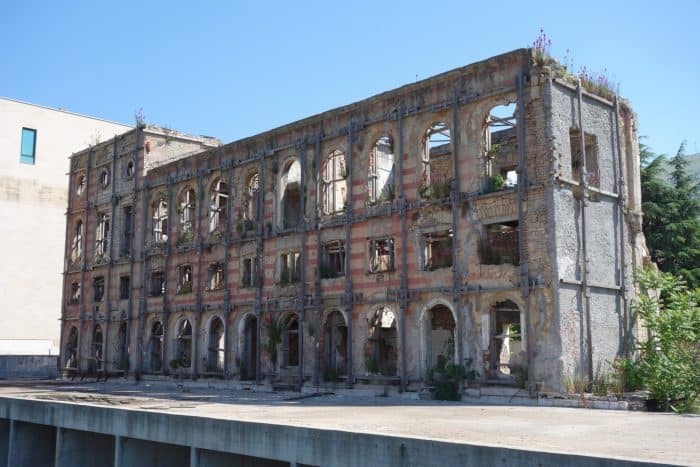
I am still unsure of the exact details, but what happened turned neighbour against neighbour. The fragile allegiance between the Bosnian’s and the Croats, fighting the common enemy of the Serbs, broke down once the Croats made land grabs. Muslim families were evicted from their houses to cross the river and create a divided society; many were even shot at as they fled with all they could carry.
These dividing lines still exist here today; people are brought up to hate the other side, taught separately and live separate lives. Miran expressed his hope that in generations to come, once those who lived through this bitter conflict are gone, the young people will begin integrating once again. Maybe the remaining bombed-out buildings of Mostar can finally be fixed once that happens, as a symbol of healing.
Vicious fighting gripped the city for over a year, the Serbs and Croats using the mountains and the river to strangle it. Cutting off communication and creating a front line out of the main boulevard. People were trapped, the city was in ruins, and eventually the Stari Most fell into the icy waters below. This was the moment the world woke up to the killing and destruction that was going on here.
Where we explored
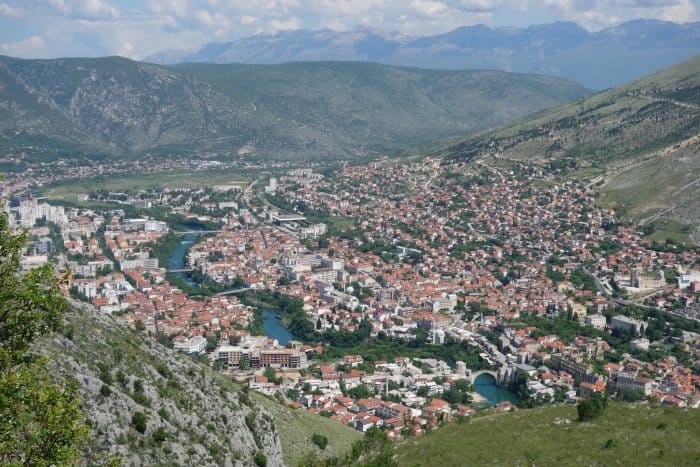
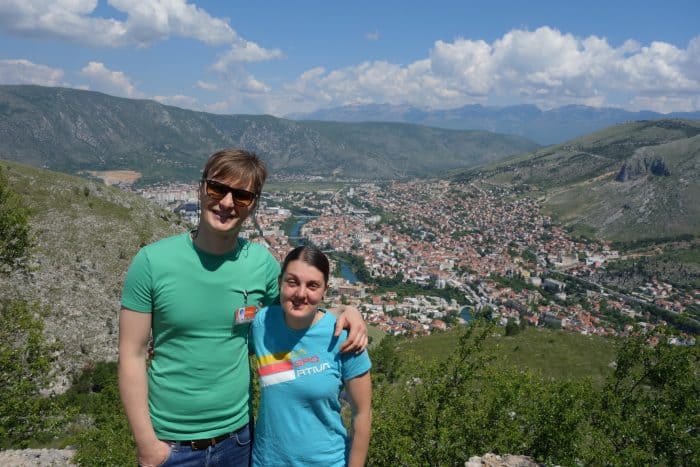
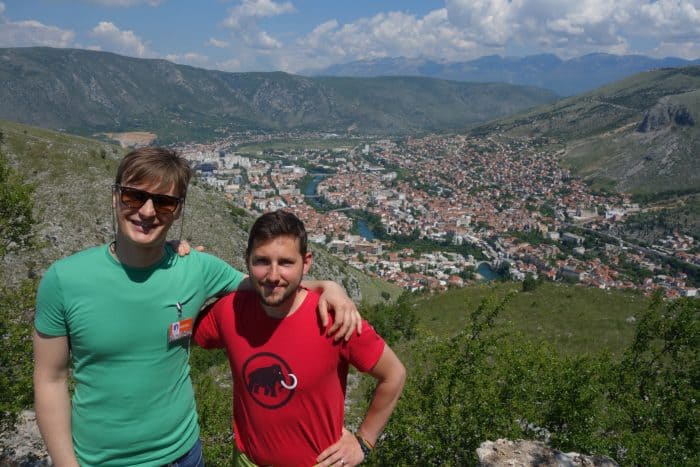
The tour began and ended in the mountains that frame the city. A picture-perfect place at first glance, the stunning emerald river flowing through an ancient Ottoman city with mountains surrounding it, paradise! Yet these exact features are the things that made the siege even more deadly. The mountains trapped the everyday people of Mostar in a conflict they wanted no part in, much like the bobsleigh track of Sarajevo, which we saw earlier on the trip.
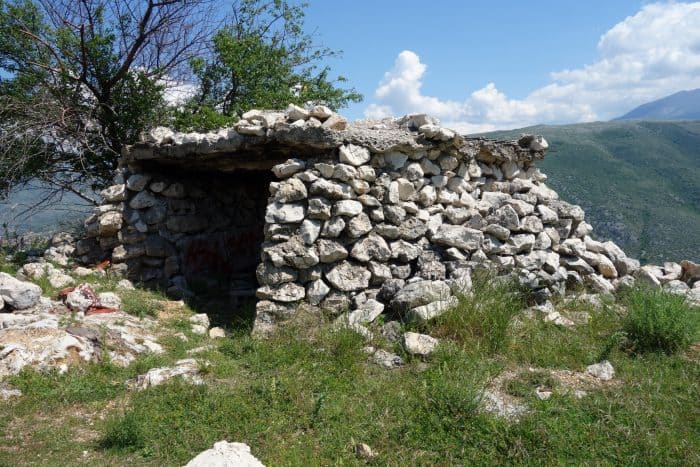
Only a few roads lead in and out, and the Serbs and Croats had them under control, sitting in the mountains with long-range weapons and blocking any way in or out. We even found a bunker up here complete with empty bullet shells from which the Serbs would fire on the city below. Even today, you should never stray off the paths up here; landmines remain as a deadly reminder of what was once a battlefield, no matter how beautiful it looks today.
Heading down into the city, we saw many of the bombed-out buildings of Mostar up close, somewhere hotels, offices, apartments, everyday places that became the front line. This front line still divides the city today; this scene of complete destruction is home to many of the bombed-out buildings and yet has made a miraculous recovery…physically, if not amongst the people.
The images Miran showed us of this street are really quite shocking; bullets and bombs reduced it to all but rubble. And yet many of these same buildings are still recognisable as the same ones standing here today. This really gives you a more focused image of an everyday city at war and how the people suffered the most. The bombed-out buildings of Mostar are ghosts of the gruesome history of these very streets.
Other explorations Outside of the Tour
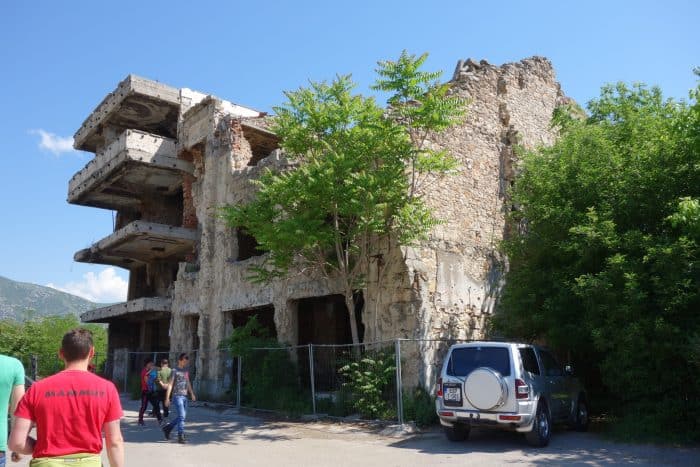
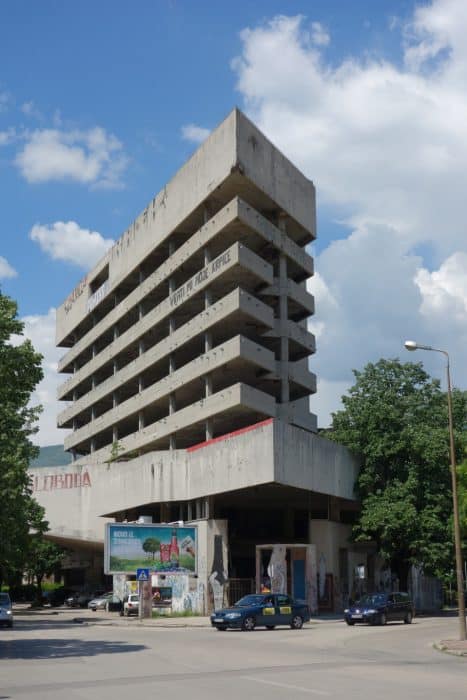
Miran showed us around many of the ruins of the city; Tito’s palace, of course, was one of the stops we had looked forward to seeing. But it was the Sniper Tower that captured our imagination the most. A modern, triangular-shaped bank building, once clad in shimmering black glass, bringing this Ottoman city into the world of the 1990’s.
People coming and going, off to work or sort their finances out. Now a crumbling shell, a haunting vantage point used by snipers to shoot anything that moved. Miran told us of the dangers within, mostly from those who use the buildings to shoot up or sleep rough in.

Having explored many abandoned buildings in the past, we scoped it out for a while; the breeze block walls used to close up the entrances were poorly and hastily put together. Getting in would be easy, but this isn’t home; this is a ruin of the Bosnian war.
We hopped over the walls and decided to go for it. Walking up the open stairwell, we felt like we were walking within history itself. Thankful the building was empty and relatively safe, climbing to the top floor, you really got a sense of the scale of the front line of Mostar and how this building in particular played such a heartless but strategically important role.
The feelings the Tour Left Us With
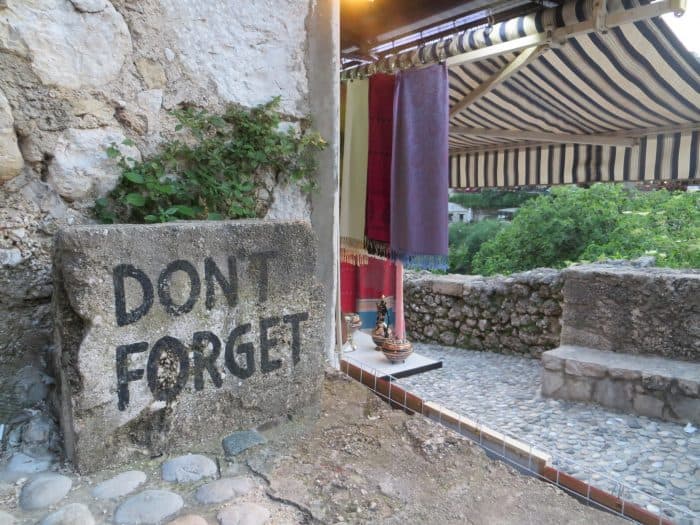
To say we were shell-shocked would be an understatement. After the tour finished and we were left in the centre of this city, we now knew so much more; we were silent, still taking much of it in. Seeing many things with new eyes, left with an air of sadness and yet a strange optimism.
The rebuilding of this city continues; one day these strange monuments to what happened will all be gone, and the scars will have healed on the surface. It has taken 20 years and still many of them remain, but it if the city itself can be rebuilt them maybe one day so too can the relationships of the people here.
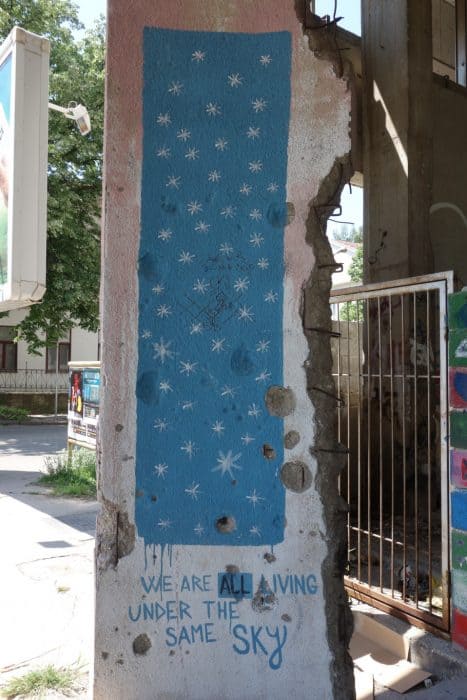
But for us, as much as we loved the bridge and the old town, this was the Mostar that will stay with us. A city still raw and yet slowly healing, those images from the television became real, the stories where someones life and in turn Bosnia began to also steal our hearts. Hearing such emotion can’t NOT have that effect upon you.
Book Your Accommodation

Booking.com
Over the course of the last 10+ years of travelling, we’ve used Booking.com to book probably around 90% of our accommodation. These days you can book anything from a luxury resort to budget hotels and even hostels and rentals similar to Airbnb.
Plus, if you make an account, you get access to their ‘Genius’ loyalty program… and DISCOUNTS. Everything is laid out super easy so you know what you’re getting, and honestly, I’m just a really big fan of the platform over other major providers.

Organise Your Trip Here
Share This Post!
For transparency’s sake: Many of the links we have on our site are affiliate links. This means that when you click one of these links and make a booking or purchase, for example: accommodation, gear, insurance or transport, we earn a small commission (at no extra cost to you). Also, know that as an Amazon Associate, we earn from qualifying purchases. Most importantly, know that we still only recommend services, gear and products we believe in and our earned commission helps us keep travelling and bringing you high-quality posts and content.


Yo, I’m Nic (they/them), one-half of The Roaming Renegades.
I’m an adventure (and halloumi) obsessed traveller with a passion for hiking mountains, exploring cities, watching Arsenal win, moshing out to Rammstein in random European fields and getting hopelessly lost on a motorbike somewhere in Asia! I am also a proud member of the LGBT+ community.
I’ve explored 80 countries, lived in Australia and New Zealand, and spent months wandering Southeast Asia, South America and Eastern Europe, all while trying to avoid growing up!
Did it work? I dunno, but my back hurts, and I still collect Pokémon cards! Who wants in?!



Those are unique structures. 🙂 Rich history and just amazing how people could maintain those. 🙂
Yes. Rich in a history that still needs telling. They are important reminders in such a beautiful city.
Their story is definitely sad and all the remaining shells of building constant reminders. I felt that same way when I was visiting Romania. You could just feel the sadness amongst the people and it hung on their shoulders like a heavy weight. Thanks for sharing so much history and a fabulous story.
Yeah. I do wonder if it is a bit of a double edged sword still having there ruins. But it is really an interesting mixture to see.