So, you’ve finally quit the 9-5, said goodbye to Susan from accounts and booked that one-way flight to freedom! Destination? Wherever the hell you want. As long as there’s strong coffee, decent Wi-Fi, and good vibes, it’s fair game to become your next remote office.
Bali? Medellin? Tbilisi? A little-known Thai beach away from the crowds? The world is your office. Whether you’re working from a hammock under palm trees or surrounded by smashed avo, crossfit gyms and flat whites, it’s all about crafting your own kind of workspace.
But before you go running off to the airport just yet, you’ve got to pack your bags first!
This isn’t your average backpacker checklist. Being a digital nomad means packing smarter and more strategically. Not only do you have clothing and standard electronics, but you’ve got laptops, hard drives, cameras and specialist work gear. That’s where this ultimate digital nomad packing list comes in!
With 8+ years of experience being a globetrotting digital nomad, I’ve kinda got it down to a fine art at this point!
Sure, this was through a back-breaking period of trial, error, and major regrets, but at least I can put my spinal sacrifices to good use by passing on this sacred knowledge!
Read on, young digital nomad Padawan, and may the wifi be ever in your favour!
Right then, let’s get this digital nomad packing list partayyy going!
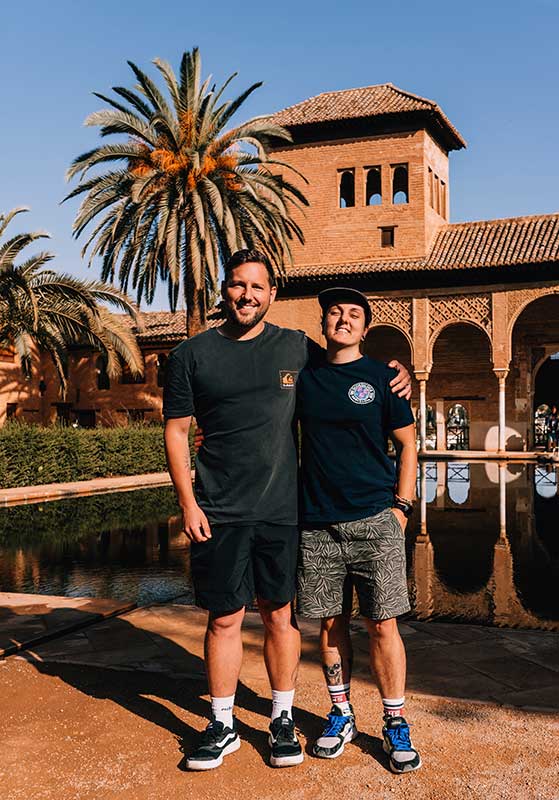
Being digital nomads has taken us to some amazing places Image: The Roaming Renegades
Digital Nomad Must-Haves: Packing List
Alright, first things first, we need to cover the must-haves when it comes to packing for a digital nomad trip. These are the non-negotiables that are coming with me wherever I am going and whatever I am doing.
Top Backpack Picks for Digital Nomads
Of course, you’re gonna need a good bag to put everything in, unless you wanna be stuck with that Ikea bag your entire trip!
Not all bags are created equally, is the thing. Some end up being logistical and comfort nightmares that’ll make you look back longingly on your days dragging that satchel through central London at rush hour!
Plus, you’re more than likely going to want to take two bags, a big backpack for your clothes and a smaller day pack for valuables. Let’s take a look at the best digital nomad backpacks.
Big Backpack –
My go-to big backpack for the last 10 years of backpacking (yes, I still have the same one and it’s still going strong) is the Osprey Farpoint. It’s the ideal backpack for a digital nomad.
These come in a range of sizes, with the 70L (which is a 55L plus 15L bag combo) being the most popular. It’s a great size for long-term/ digital nomad travel, but is a little too big for carry-on only travel. Having said that, this suits the slow travel of the digital nomad life well.
As a digital nomad backpack, it’s hard to beat. In fact, I am going out on a limb and saying, yeah, the Osprey Fairpoint is the best digital nomad backpack out there!
Whilst the Osprey Farpoint does come with a detachable day pack (at most, but not all sizes), I found that when I made the transition from backpacker to digital nomad, I needed a different, more specialised front pack.
As a photographer, I use the Wandrd Prvke with the side access door and camera cube. This backpack also has a laptop sleeve, and the dedicated sections are ideal not only for camera gear, but for keeping different items separate if you’re an organisation freak like me!
It’s mega comfortable when when fully loaded. Has side access so you can grab your camera on the go. The material is weather resistant and there’s even a secret passport stash pocket!
There’s an expandable upper section with a roll top to keep gear separate from your camera.
I might have already mentioned it, but I like to keep my shiz organised and being a digital nomad, it’s even more important to me to know where all my gear is.
Packing cubes are a non-negotiable for me when it comes to packing, and I use them for both my clothing and my accessories to keep everything neat and tidy. Not only does it mean I can easily find anything I’m after, but it also helps maximise the space in my bags.
Whether you’re bringing only minimalist travel gear or your whole wardrobe, packing cubes are a game-changer and should be on any digital nomad packing list.
So, you might be wondering, “What do nomads wear?” Well, unfortunately, I am still just as unstylish as my backpacking years, so not much has changed there! But let’s have a look at what I typically pack clothing-wise and what I recommend packing for the digital nomad.
Things to pack for a digital nomad packing list
5/6 T-shirts (I usually leave a bit of space for buying some new ones)
As you can see, my packing list for digital nomad trips isn’t too different to when I’m packing for Southeast Asia or backpacking, but seeing as I will be staying put for longer each time and not travelling so often, I do tend to give myself a little more scope for extras. But on the whole, it’s a minimalist digital nomad packing list.
Whilst the vast majority of us head for sunny climes when we escape the drudgery of home, I understand there are some freaks that live amongst us who prefer it cold! Or, some of us who accidentally stumble upon colder weather (yes, that’s me currently in Autumn in Chile). So whilst most of the top digital nomad destinations might be in warmer places, it’s best to always be prepared.
So here are some items we always travel with, just in case we run into some cold weather or fancy a hike at some altitude (even in Southeast Asia, it can get cold on the mountains!)
Base layers (These are mega light, small, and add so much warmth)
Down Jacket (Super lightweight, put in a compression sack)
Buff (Packs down well, adds so much warmth when called on)
As you can see, the digital nomad wardrobe is as complicated as you want to make it, and for me, the thing I love most about remote work is how casual it is.
Checklist of Travel Tech and Accessories for Digital Nomads
Right then, as digital nomads on the road, we’re obviously going to be working… or pretending to at least! Here are the essentials when it comes to digital nomad tech.
Laptop
Of course, where would any self-respecting digital nomad be without their trusty laptop? It’s probably one of the most essential digital nomad tools if we’re honest! But which one should you pick?
Whilst I might have been able to get away with a cheap Windows laptop back in the day or even a lightweight MacBook Air, these days my resource-heavy workload requires the processing power and storage of the mighty MacBook Pro.
Whilst these will set you back a significant amount of cash, they are also leaders in their field, and honestly, I’ve always been super impressed by their longevity. My previous MacBook was only replaced due to outdated graphics, and it actually still works fine after 10 years on the job!
Keeping all your important documents, photos, and files backed up on the road is super important. I’m a belts-and-braces kinda guy when it comes to storing my data, and I utilise both cloud storage and physical backups. So for that reason, I consider this to be a pretty essential item on any digital nomad packing list.
I won’t bore you with the finer details of my, admittedly overboard, backup regime; suffice to say that these days you can get high-capacity lightweight HDD and SSD drives at super affordable prices. So there’s literally no reason not to back yo shit up!
And if you’ve got a Mac (which you should have!), their built-in Time Machine software makes it an automated process that will store your entire set-up on an external drive for you.
I personally have both an SSD and a HDD, and both are “rugged” models designed to be more durable, which makes them ideal bits of nomad tech.
Another essential tech item for my digital nomad packing list is portable power banks. These are great for keeping your gear charged when you don’t have access to power outlets. That can be anything from your phone to your camera gear or even your laptop if you have the right one.
I always have at least one in my bag when I’m travelling, doing my photography or working outside of my accommodation.
Following on from that is my trusty universal travel adapter, one of the most overlooked but important nomad accessories.
Moving from region to region means switching from one adapter to the next. I mean, who knew Argentina uses Australian-style plugs, whilst Colombia uses US-type plugs, and Brazil uses European plugs? What a nightmare!
Rather than having a bag full of an assortment of different adapters rattling around, I recently invested in a universal travel adapter, which includes USB and USB-C slots, and honestly, I don’t know why I didn’t do it before! It might even be one of the biggest travel lessons I’ve learnt all year!
I also pair this with a standard plug (UK for us), which takes multiple USBs, so I can charge my excessive number of cameras at once!
If you’re anything like me, you get easily distrac… oh, a cute dog! Sorry, where was I?! You get the idea.
I am a proper scatterbrain, and whilst I love the busy environments of co-working spaces, sometimes I need to get down to work and grind it out! I also have frequent calls, and a good digital nomad headset is essential. I personally prefer a good pair of over-ear noise-cancelling headphones.
This, plus absolutely hating flying (yeah, I know!), means I don’t travel anywhere without my noise-cancelling headphones. There’s nothing like blasting Rammstein whilst cranking out some top-quality work.
Ain’t no way my stuff is just being thrown into a backpack to just float around aimlessly! Following sage life advice from my Grandma, there’s a place for everything, and everything has a place!
Whilst I have deffo inherited OCD from my Gran, it also means that all my important wires, charging cables, memory cards, readers, hard drives, etc., can be found easily and never go missing. The nomad travel bag is a finely crafted work of art, my friends!
Trust me, once you get a tech pouch, you’ll wonder how you ever travelled without one before, and it will be an essential on your digital nomad packing list.
Now you’ve made what is probably one of the biggest investments of your life in your fancy new laptop, you’ll want to keep that sucker protected on the road.
Get yourself a good laptop case with a rigid or semi-rigid exterior to protect it from any unexpected bumps and drops. I use a Thule case, and it’s seen me through some tough conditions, including motorbiking through Vietnam with my laptop on my back!
Plus Travel Insurance: The Most Important Nomad Necessity
Now, when it comes to digital nomad essentials, I am gonna end this section with what I think is the most important one – Insurance specific to digital nomads.
We nomads need insurance that offers something different from just your standard travel insurance. Some might also opt for comprehensive health insurance, or want policies they can take out whilst travelling, pay monthly, and even pause if they head home for a few months. We highly recommend the policies offered by SafetyWing; they are designed with digital nomads in mind and cover our specific needs well.
SafetyWing also offers an optional additional electronics cover, so you can protect not just yourself, but your livelihood too.
Travel insurance is one of those annoying things that no one likes to think about, let alone pay for, when you’re planning your next trip. It can also be bloody annoying as a backpacker/long-term traveller to find affordable coverage that meets the itinerary-less lifestyle (*cough* World Nomads *cough*).
So instead of getting subpar travel insurance, now we just always go with SafetyWing. It takes like 5-10 minutes to purchase your policy and essentially functions as a monthly subscription plan with near-global coverage!
Other Optional Digital Nomad Gear for Working on the Road
I’ve covered all the essential, non-negotiable items on my digital nomad packing list, so now let’s look at a few other optional extras depending on how you like to work and travel. These nomad travel accessories make working on the road a breeze.
Kindle (or Other E-Reader)
Having some downtime is essential for a digital nomad, and an ideal way to do that away from social media is to read.
Whilst I would love to pack a mountain of hardback classics, it’s just not the most practical way to do it! Instead, a Kindle (or other e-reader) is a lightweight and portable solution that is ideal for bedtime reading, flights and those hours spent waiting in airports!
So you never have to miss out on reading your favourite digital nomad book whilst pondering your next business idea during your latest 12-hour stint in Changi Airport!
Having a laptop set up that’s healthy for your posture is essential to staying in good shape while working on the road. Unfortunately, we can’t always have the perfect desk and chair set up in every office, but we can at least go some way to customising our working space.
A laptop stand that elevates your computer so that it’s the right height is one step in creating that healthy workspace. They’re cheap, light and easy to throw into your bag.
Now you might be wondering – if your laptop is now sitting as high up as a computer monitor, how am I going to type?! Well, that’s where a wireless mouse and keyboard come in to complete the setup.
You can even get an ergonomic mouse that keeps your wrist at the optimal angle. Either way, both of these items will go a long way toward avoiding the sort of back issues that can come from long hours on a laptop.
Losing luggage is a nightmare at the best of times, but when you’re a digital nomad, it can mean the difference between making your next paycheck or not.
Popping an AirTag into your bags is a great way to keep track of their location to make sure they don’t get lost or go walkabouts. I keep one in my big bag as well as my camera bag, plus I have “Find My” on my laptop and phone, too. They’re a small but game-changing addition to any digital nomad packing list.
Capturing all our adventures on the road is not just about keeping those memories alive (and let’s be honest, one of the big perks of being a digital nomad), but for us it’s also part of our job too! So having a good camera is essential for both earning a living and then ya know, showing it off on Insta!
Here are the cameras and accessories we recommend for digital nomads serious about photography
Sony A7 IV & 24-105 f4 Lens
This is our go-to travel camera and lens combo. It offers full frame quality, 33 megapixels, eye autofocus, great low light quality, dual card slots and is lightweight for its size.
The 24-105 f4 lens is the perfect all-rounder for travel and virtually never leaves our camera. Its constant f/4 aperture, inbuilt OSS + IBIS, plus weather-sealed exterior make it super versatile for almost all travel situations.
Combined with the great high ISO performance of the Sony A7IV, impressive bokeh at the longer reaches and great weight/ size trade off, you won’t miss wider apertures when shooting on the road.
A GoPro has been a staple in our bags since day one, even before we upgraded to the “big camera” and it still is.
Whether we’re making content swimming with turtles on the Gili islands, filming our motorbike adventures in remote Vietnam, or just grabbing selfies in the hotel pool, we don’t travel anywhere without it. It’s so small and light, too, that it takes up virtually no room.
We are pretty basic, I’ll be honest, when it comes to lotions and potions, and we like to keep things as light and simple as possible. So if you’re one of those extra people with serums and god knows what else, then you’re gonna have to find some extra space! But for us, these are the essentials.
Other Personal Items – Such as feminine hygiene products/ shower cap.
Toiletries bag
Oh, and you’ll need a decent place to put all this stuff! Never underestimate the importance of a good toiletries bag. The days of backpacking with my toothbrush and a 2L bottle of Head and Shoulders in a Tesco bag for life are well and truly over for this seasoned traveller!
These days, I have a Wandrd toiletry bag that keeps everything organised, has a built-in antimicrobial toothbrush sleeve as well as a water-resistant design to avoid spills. It might be more expensive than a 10p bag, sure, but it deffo keeps things compact.
Ya know, shit happens, so a basic first aid kit is essential for fixing up those lil boo boos here and there! Is a nomad medical kit any different? Maybe throw in a few extra Xanax tablets! :-p
Painkillers (Ibuprofen/ paracetamol) – Be careful with anything stronger.
Allergy tablets and other personal medication
Plasters (band aids)
Small bandages/ gauzes and safety pins
Antiseptic creams/ iodine/ alcohol wipes, and a sterile saline solution
A first aid kit is needed if you’re gonna be shit on a scooter! Image: The Roaming Renegades
Essential Travel Documents Checklist
For those living and working on the road, it’s important to keep a checklist of important documents. Some you’ll need often, others are more of a “just in case” kinda deal.
Prescription list/doctor’s letter (for carrying meds)
Emergency contact info (on paper and phone)
Safe location and backup location for logins and passwords.
A small amount of emergency cash in crisp USD
Top Tips –
Keep digital and physical copies of all important documents. Keep these separate. Keep digital copies on cloud storage and also email yourself a copy for emergency access.
Keep items like passports inside something like a sandwich bag, and have a dry sack at hand that you can just throw them all inside if needed.
As you might imagine, heaven forbid these items just get thrown into my backpack, oh hell no! I have a small cross-body bag with various sections where I keep all my travel documents/backup bank cards/ PADI card, etc.
This fits neatly inside my front pack, which is sectioned with OCD like qualities into a camera cube, tech pouch, laptop charger pouch and documents bag. This can then be removed and worn separately for either safety or when I need my documents to hand, such as in airports or border crossings.
This is one of my most recent nomad gear innovations, and honestly, I think I’ve outdone myself with this one!
Ok, so we’ve got the end of the packing list, but I’ve got a few bonus tips for you when it comes to working and travelling on the road.
Whether you’re a newbie or a seasoned digital nomad, hopefully, there are some useful nuggets in here for ya on this short and sweet digital nomad travel tips section.
How to Manage Your Money as a Digital Nomad
Ahh, money money money, it’s the name of the game and the root of all evil, but for location-independent entrepreneurs, it’s what keeps us moving.
But one way or another, you’re gonna need to lock in a more long-term solution than withdrawing all your savings, stuffing it into your back pocket and hoping for the best (literally met a dude in a hostel doing exactly that back in 2016 and we’re still mates to this day!)
So, this is my system.
I use a primary account for withdrawing and paying that doesn’t charge fees, Such as Wise, Revolut, Starling (Mastercard).
Paul also has these accounts, and we keep these cards separate as backups.
Transfer Your Money Abroad Or Grab An International Card
In the early days of travel we would get a stack of money out and carry it with us… It wasn’t the best way to avoid a disaster really, but getting constantly stung by ATM fees wasn’t much better,
Now we have Wise and, phew, things have CHANGED!! With our Wise account we can keep money in multiple currencies as well as withdrawing cash and paying by card without paying transaction fees. Plus, if you work online like we do, then it’s a fantastic platform for payments.
Use a credit card with a frequent flyer program for larger purchases (such as an Amex).
Have my main savings in a separate savings account (An ISA with Halifax), not accessible directly by card.
Have another stocks & shares ISA and pay into it monthly for long-term savings.
Also have other backup cards for other UK accounts. These only have a small amount of money left in case the cards are stolen. These Visa accounts are emergency options, as our Mastercard rarely doesn’t work. They do charge a small fee, so they are used only when needed.
Emergency cash in USD – Around £150. $50 of this is in small denominations for border crossings or “issues” with Thai traffic police!! IYKYK!
The Roaming Renegades Recommends Investing in an eSIM
Staying connected as a digital nomad is pretty essential, I think we’d all agree. Whilst most of our business is going to be done over Wifi, for most of us, we need to be able to reply to emails and WhatsApp messages on the go.
Plus, booking Ubers or Grab bikes, checking a restaurant on Tripadvisor before heading in, translating important info, or finding your way home in a new city… having data is pretty essential for day-to-day travel too.
Having an eSIM is the perfect way to ensure you’re connected as soon as you land at your next destination. They’re cost-effective, easy to set up, and you can top up when needed.
Useful Apps and Platforms While Travelling for Digital Nomads
Here’s a handy list of some apps that I find super useful as a digital nomad. Whether for booking accommodation, organising transport, keeping entertained, or just making sure I don’t get lost… again!!
Check Out Our Digital Nomad List for Best Travel Apps
Final Thoughts on the Digital Nomad Packing List: Grab Our Checklist!
All right then, we got there! Hopefully, this digital nomad packing list has answered a few questions and quelled any doubts you had, so you can head off with confidence.
Whether you’re a minimalist nomad forever forgetting essential items or you’re guilty of overpacking, this list has been made to bridge the gap. From crafting your first remote year packing list to making a new life on the road, it’s important to get things right to make the transition as smooth as possible.
Let us know if you think we’ve forgotten anything or if you’ve got any of your own top tips for a digital nomad checklist. What are your go-to nomad essentials?
Working by the pool is the ultimate digital nomad flex, right?! Image: The Roaming Renegades
Buy Us a Coffee
A few people have asked us recently how they could help us out on our travels, so we thought we’d add our very own tip jar for those who can’t support us by clicking through our affiliate links.
We work hella hard on this site to bring you all the most epic and up-to-date travel info from around the planet. So if you’ve enjoyed what you’ve seen, then we’d appreciate anything, no matter how small, you can contribute as a thank you.
Above all, thank you for being here and reading our content, it means the world to us.
You’ll need a couple of decent backpacks, a week’s worth of clothes, some quality tech gear and all of the essential documents and travel insurance.
The ability to earn money remotely, good WiFi, a Passport/ visas and the will and desire to travel the world. You’ve also got to realise that there are some challenges with remote work and embrace them!
For transparency’s sake:Many of the links we have on our site are affiliate links. This means that when you click one of these links and make a booking or purchase, for example: accommodation, gear, insurance or transport, we earn a small commission (at no extra cost to you).Also, know that as an Amazon Associate, we earn from qualifying purchases. Most importantly, know that we still only recommend services, gear and products we believe in and our earned commission helps us keep travelling and bringing you high-quality posts and content.
Yo, I’m Nic (they/them), one-half of The Roaming Renegades.
I’m an adventure (and halloumi) obsessed traveller with a passion for hiking mountains, exploring cities, watching Arsenal win, moshing out to Rammstein in random European fields and getting hopelessly lost on a motorbike somewhere in Asia! I am also a proud member of the LGBT+ community.
I’ve explored 80 countries, lived in Australia and New Zealand, and spent months wandering Southeast Asia, South America and Eastern Europe, all while trying to avoid growing up!
Did it work? I dunno, but my back hurts, and I still collect Pokémon cards! Who wants in?!
We value your privacy. We use cookies to improve your experience on our site. By using our site, you consent to cookies.
This website uses cookies
Websites store cookies to enhance functionality and personalise your experience. You can manage your preferences, but blocking some cookies may impact site performance and services.
Essential cookies enable basic functions and are necessary for the proper function of the website.
Name
Description
Duration
Cookie Preferences
This cookie is used to store the user's cookie consent preferences.
30 days
These cookies are needed for adding comments on this website.
Name
Description
Duration
comment_author
Used to track the user across multiple sessions.
Session
comment_author_email
Used to track the user across multiple sessions.
Session
comment_author_url
Used to track the user across multiple sessions.
Session
Statistics cookies collect information anonymously. This information helps us understand how visitors use our website.
Google Analytics is a powerful tool that tracks and analyzes website traffic for informed marketing decisions.
Used by Google Analytics to determine which links on a page are being clicked
30 seconds
_ga_
ID used to identify users
2 years
_gid
ID used to identify users for 24 hours after last activity
24 hours
_gat
Used to monitor number of Google Analytics server requests when using Google Tag Manager
1 minute
_gac_
Contains information related to marketing campaigns of the user. These are shared with Google AdWords / Google Ads when the Google Ads and Google Analytics accounts are linked together.
90 days
__utma
ID used to identify users and sessions
2 years after last activity
__utmt
Used to monitor number of Google Analytics server requests
10 minutes
__utmb
Used to distinguish new sessions and visits. This cookie is set when the GA.js javascript library is loaded and there is no existing __utmb cookie. The cookie is updated every time data is sent to the Google Analytics server.
30 minutes after last activity
__utmc
Used only with old Urchin versions of Google Analytics and not with GA.js. Was used to distinguish between new sessions and visits at the end of a session.
End of session (browser)
__utmz
Contains information about the traffic source or campaign that directed user to the website. The cookie is set when the GA.js javascript is loaded and updated when data is sent to the Google Anaytics server
6 months after last activity
__utmv
Contains custom information set by the web developer via the _setCustomVar method in Google Analytics. This cookie is updated every time new data is sent to the Google Analytics server.
2 years after last activity
__utmx
Used to determine whether a user is included in an A / B or Multivariate test.